
Static Pressure Testing for Pool Pipe Leak Detection: What It Can and Can’t Find
How to Detect Pool Pipe Leaks Without Specialized Equipment
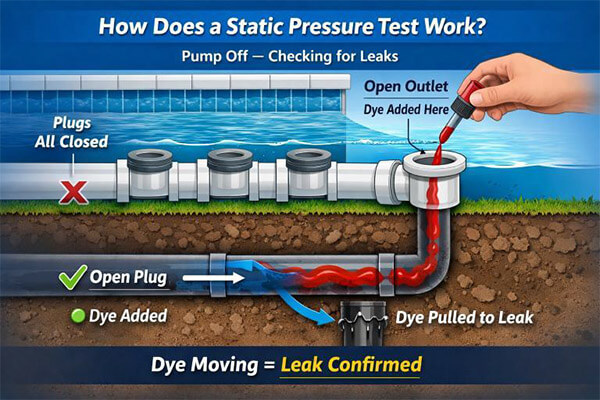
A static pressure test is a simple yet effective method to determine if your pool or spa plumbing line has a leak. While it won’t pinpoint the exact location of the leak, it’s a great first step to confirm the presence of one before calling a professional.
If you suspect a plumbing leak and want to verify it yourself, this guide will walk you through the process step by step.
Still unsure if water loss is from plumbing or the pool structure? Download our FREE Pool Leak Detection Ebook and learn how to identify leaks like a pro—before they become costly repairs! Get your free copy now!
What Is a Static Pressure Test?
A static pressure test checks for leaks in pool plumbing lines without using external pressure.
The process involves isolating a single pipe, sealing all outlets except one, and observing water movement with dye.
Key Benefits:
✅ No advanced skills required
✅ Minimal tools needed
❌ Confirms a leak but doesn’t locate it
If you need to pinpoint the exact location of an underground leak, check out our video guide:
👉 How Underground Pool Leaks Are Professionally Detected
 How Does a Static Pressure Test Work?
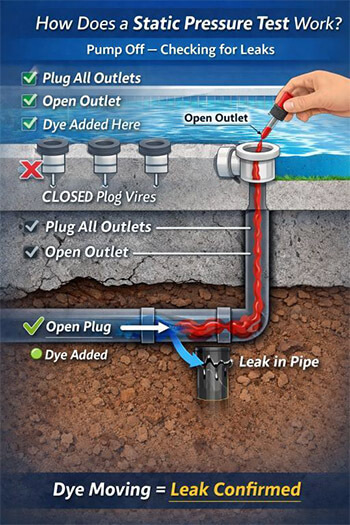 How Does a Static Pressure Test Work?
The test works by observing water movement in a static (pump-off) state.
Any water movement indicates a leak.
Basic Principle:
1. Plug all outlets on the test line.
2. Leave one outlet open.
3. Release dye near the open outlet.
4. If a leak exists, the dye will be pulled into the pipe, confirming water loss.
📌 Important: This test only verifies the presence of a leak—it does not locate the leak underground.
Tools You’ll Need for a Static Pressure Test
To perform this test, gather the following tools:
- Rubber or threaded pool plugs or even better “cones” for dye test
- One open plug or open cone
- Pool dye test kit
How Many Plugs Do You Need?
The number of plugs depends on the outlets connected to the line you’re testing.
Example:
For a return line with 3 outlets:
- Use 2 closed plugs and 1 open plug.
Think of the plumbing like a fork:
- One pipe enters.
- Multiple outlets exit.
By closing all but one outlet, suction is concentrated at a single opening, making dye movement easier to detect.
🎥 Watch the Static Pressure Test for Pool Pipe Leak Detection (Step-by-Step Video Guide)
See exactly how the test is performed in real time and what dye movement actually looks like during a pool pipe leak.
👉 Watch the Static Pressure Test on YouTube
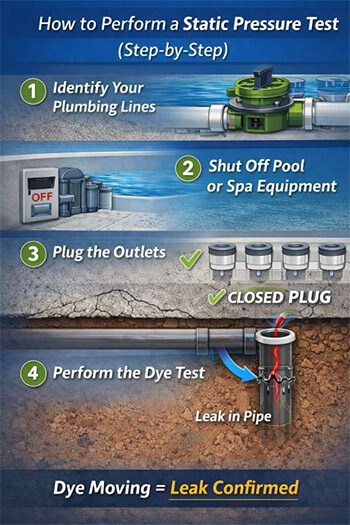
How to Perform a Static Pressure Test (Step-by-Step)
1. Identify Your Plumbing Lines
Before testing, determine:
● How many lines you have.
● Which outlets are connected to each line.
Pro Tip:
Run the pool or spa system and use diverter valves to shut off one line at a time. Outlets with no flow belong to the closed line.
2. Shut Off Pool or Spa Equipment
 2. Shut Off Pool or Spa Equipment
● Turn off the pump, heater, and auto-fill.
● Ensure no water
● Water level should be at normal operating height (typically halfway up the skimmer).
3. Plug the Outlets
Example:
For a hot tub with 8 return jets (all on one plumbing line):
● Use 7 closed
● Leave 1 open plug for dye
4. Perform the Dye Test
● Release small amounts of dye near the open outlet.
● Avoid creating water movement.
Results:
🔴 Leak present: Dye travels into the pipe.
🟢 No visible movement:
🔴 Dye slowly disperses
Why “No Dye Movement” Doesn’t Always Mean No Leak
It’s important to understand that static pressure testing has limitations.
Factor 1: Pressure-Only Leaks
Some cracks only leak when the pump is running.
- These leaks won’t show dye movement during static testing.
- Water loss occurs only under pressure.
👉 Learn more: What a Pressure Leak Looks Like
Factor 2: Leaks Above Water Level
If a leak is:
- Near equipment.
- Above the pool or spa water level.
There will be no suction or dye movement during a static test, but the system may still lose water when operating.
When Static Pressure Testing Works Best
Static pressure testing is most effective when:
- The leak is constant.
- The leak is below water level.
- Water loss occurs even when equipment is off.
For other scenarios, a full pressure test is required.
👉 Watch our guide: How to Pressure Test Pool Spa Plumbing Like a Pro
🔍Want to Learn How to Find Pool Leaks Like a Pro?
📘 FREE Ebook:
How to Find Pool Leaks Before They Get Expensive Inside, you’ll learn:
- DIY leak tests homeowners can safely perform.
- How to differentiate plumbing leaks from structural leaks.
- When to stop DIY and call a professional.
👉 Download the Free Pool Leak Detection Ebook
✅ Take the Next Step (Free Resources)
👍 Join Our Facebook Communities
▶ Subscribe to Our YouTube Channel
Watch real leak detection cases, pool inspections, and expert tips.
📸 Instagram: @poolleakdetectionllc
🛒 Visit Our Amazon Storefront
Recommended pool tools, testing equipment, and accessories.