
How to Tell If Your Pool Is Leaking: The 24-Hour Water Loss Test (No Bucket Needed)
Worried about a potential leak in your pool or spa? You’re not alone. Unexplained water loss is a common concern for pool owners, and identifying a leak early can save you from costly repairs, equipment damage, and high water bills.
In this guide, we’ll walk you through the 24-hour water loss test, a reliable alternative to the traditional bucket test, to help you determine if your pool or spa is losing water beyond normal evaporation.
If your pool loses more water with the pump running than when it’s off, you likely have a plumbing leak.
If water loss occurs in both cases, the leak may be in the pool structure (liner, light niche, shell).
The 24-hour water loss test helps confirm whether a leak exists—but not its exact location.
Why Detecting a Pool Leak Early is Crucial
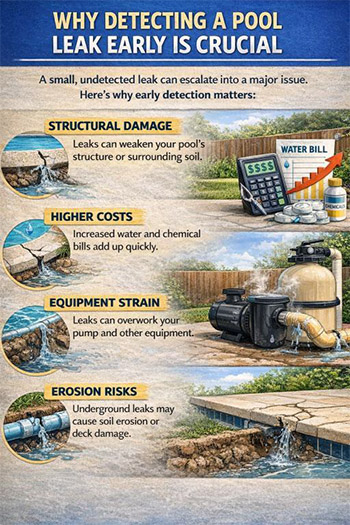 A small, undetected leak can escalate into a major issue. Here’s why early detection matters:
● Structural Damage: Leaks can weaken your pool’s structure or surrounding soil.
● Higher Costs: Increased water and chemical bills add up quickly.
● Equipment Strain: Leaks can overwork your pump and other equipment.
● Erosion Risks: Underground leaks may cause soil erosion or deck damage.
Before calling a professional, this test will help you confirm if a leak exists and provide useful data for a leak detection expert.
What Is Normal Pool Water Loss?
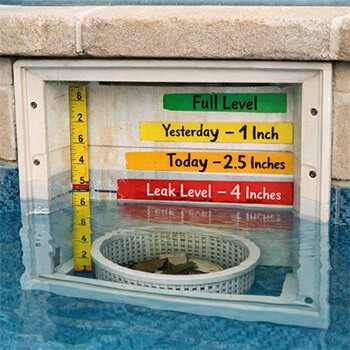
Most pools lose ⅛–¼ inch of water per day due to evaporation, depending on temperature, wind, and sun exposure. Anything beyond this—especially consistent loss—may indicate a leak.
⚠ Important: Do not perform this test if rain is expected. Rainfall can skew results and lead to inaccurate conclusions.
Step 1: Monitor and Mark the Water Level
Start by closely observing your pool or spa’s water level. Here’s how:
1. Measure and Record Daily Water Loss
If you have multiple water features (e.g., attached spa, catch basin), mark and measure each one separately.
Important: If your pool has a raised spa sharing the same plumbing, the spa’s water level might drop when you turn off the pump. This isn’t necessarily a leak; it’s often normal equalization. Water naturally flows from the higher spa to the lower pool until the levels balance out. Before assuming you have a leak, let the system settle and then measure the water loss.
👉 See the detailed explanation below.
2. Eliminate Water Movement
● Turn off all pool and spa equipment.
● Let the water settle for at least 5 minutes.
3. Mark the Water Level
● Inside the skimmer box or,
● Along the pool wall or,
● Any clearly visible, repeatable reference point
 Step 2: Perform the 24-Hour Pump-Off Test
 Step 2: Perform the 24-Hour Pump-Off Test
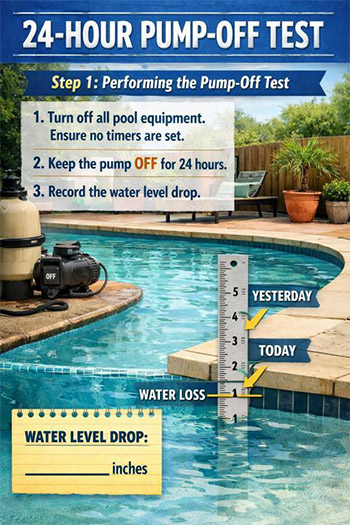
To assess water loss, you’ll need to conduct two separate 24-hour tests: one with the pump off and one with the pump on.
Pump-Off Test Instructions
1. Turn off all pool equipment and ensure no timers are set.
2. Keep the pump off for a full 24 hours.
3. Record the water level drop.
Pro Tip: Use rubber or threaded plugs to seal suction and return lines. This helps identify whether the water loss is due to the pool structure or plumbing lines.
If you’re not comfortable plugging lines, you can still perform the test without plugs. However, plugging lines provides more accurate insight into whether the leak is structural or plumbing-related.
Understanding Pump-Off Results
● Little to No Water Loss: Likely normal evaporation.
● Consistent Water Loss: Possible structural leak (e.g., liner, light niche, shell, fittings).
If water loss is minimal but noticeable, repeat the test for another 24 hours to confirm consistency.
Evaporation Tip: Avoid testing during extreme heat. If unavoidable, test from sunset to sunrise to minimize evaporation interference.
Step 3: Perform the 24-Hour Pump-On Test
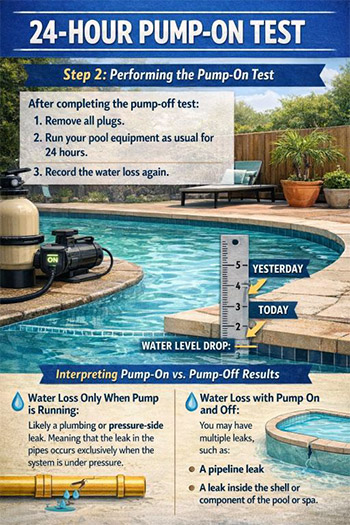 After completing the pump-off test:
1. Remove all plugs.
2. Run your pool equipment as usual for 24 hours.
3. Record the water loss again.
Interpreting Pump-On vs. Pump-Off Results
Water Loss Only When Pump is Running: Likely a plumbing or pressure-side leak. Meaning that the leak in the pipes occurs exclusively when the system is under pressure.
Water Loss with Pump On and Off: You may have multiple leaks, such as:
● A pipeline leak
● A leak inside the shell or component of the pool or spa.
If the water loss is the same with the pump on and off, it’s more likely that the leak is in the pool’s shell or component.
However, if the water loss is greater when the pump is running, this points to a plumbing leak in the system.
Keep in mind that it’s also possible to have multiple leaks—both in the pool shell and the plumbing system—so thorough testing is essential.
These measurements are invaluable for professional leak detection services.
What This Test Can—and Cannot—Tell You
✅ What It Can Do:
● Confirm if your pool or spa is
● Indicate whether the issue is structural or plumbing-related.
● Help you decide if you need a leak detection diver or an underground leak detection specialist.
❌ What It Cannot Do:
● Pinpoint the exact location of the
Finding the precise source often requires specialized tools and expertise.
Special Consideration: Pools with Raised Spas That Share Plumbing
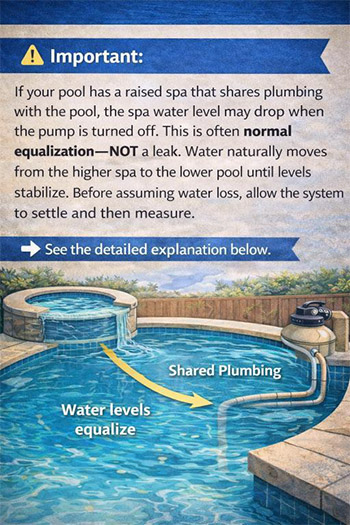 If your pool has an attached spa that sits higher than the pool and both bodies of water share suction and/or return plumbing, water level behavior can look misleading during a leak test.
Here’s what you need to understand:
When the pump is turned off, water naturally seeks its own level. If the spa and pool are hydraulically connected, gravity will cause water in the elevated spa to drain back through the shared plumbing into the pool until both bodies reach equilibrium.
What This Means During Testing
● The spa water level will drop, sometimes noticeably.
● The pool water level may rise slightly.
● This equalization is not a leak — it’s normal hydraulic behavior.
Many pool owners mistakenly interpret this as water loss when, in reality, it’s simply water redistributing between connected vessels.
Why This Happens
In a shared plumbing configuration:
● Return lines and/or suction lines act as a hydraulic bridge.
● Without pump pressure or functioning check valves to isolate the spa, gravity pulls water from the higher elevation to the lower one.
● The system stabilizes only when both levels match.
How to Avoid Misreading Results
If your spa is elevated and shares plumbing:
✅ Perform water-loss measurements after levels stabilize
✅ Mark both spa and pool levels separately
✅ Understand that initial equalization is expected
✅ Only measure ongoing loss after stabilization
If the spa continues to drop after equalization, or if the pool loses water independently, that may indicate a genuine leak requiring further investigation.
When to Call a Pool Leak Expert
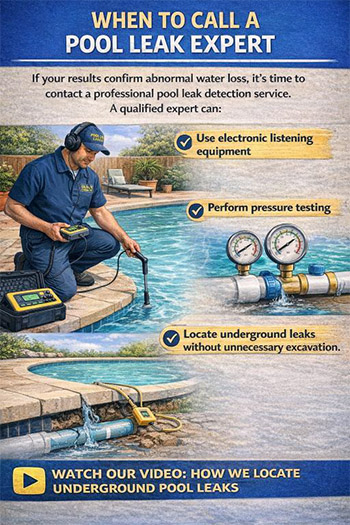 When to Call a Pool Leak Expert
If your results confirm abnormal water loss, it’s time to contact a professional pool leak detection service. A qualified expert can:
● Use electronic listening equipment.
● Perform pressure testing.
● Locate underground leaks without unnecessary excavation.
🎥 Watch Our Video: How We Locate Underground Pool Leaks
Professional Pool Leak Detection in the Northeast
If you’re in New York, New Jersey, Connecticut, or Pennsylvania, Pool Leak Detection LLC is your trusted local expert. We specialize in:
● Structural leak detection
● Underground plumbing leaks
● Vinyl liner and pool light leaks
📞 Ready to Get Answers?
If your test results show abnormal water loss, don’t guess—get clarity from a professional.
👉 Book a Call or Get a Free Leak Detection Quote
Our experts can accurately locate the leak and help prevent further damage to your pool or spa.
Learn More About Pool Leak Detection
 Learn More About Pool Leak Detection
📘 Free Pool Owner Ebook
Get our free pool leak detection ebook and learn:
- How to spot leaks early
- Common leak locations most homeowners miss
- When DIY tests are enough—and when to call a pro
Learn More About Pool Leak Prevention
For more expert tips, visit our website. Explore resources like:
- How to fix a large tear in the liner
- Choosing the right robotic pool vacuum
- Leak prevention and maintenance tips
Our Mission: To keep your pool, its users, and your wallet safe.
Frequently Asked Questions (FAQ)
How much water loss indicates a pool or spa leak?
Most pools lose ⅛ to ¼ inch of water per day due to normal evaporation. If your pool consistently loses more than ¼ inch per day, especially when the pump is off, it may indicate a leak.
Can evaporation look like a pool leak?
Yes. High temperatures, wind, low humidity, and sun exposure can increase evaporation. That’s why the 24-hour water loss test is important—it helps distinguish normal evaporation from actual leaks by comparing pump-on and pump-off water loss.
Should I turn off my pool’s auto-fill system during the test?
Yes. Always turn off auto-fill systems before starting the test. Auto-fill can mask water loss and produce inaccurate results, making it difficult to confirm whether a leak exists.
Can I perform this test without plugging the plumbing lines?
Yes, you can still perform the test without plugs. However, plugging suction and return lines improves accuracy by helping determine whether water loss is coming from the pool structure or the plumbing system.
What does it mean if my pool only loses water when the pump is running?
If water loss occurs only when the pump is on, the leak is most likely in the
plumbing system, such as:
- Pressure-side return lines
- Underground pipes
- Valves or fittings
What if my pool loses water with the pump both on and off?
This often indicates multiple leaks, such as:
- A structural leak (vinyl liner, shell, light niche)
- A plumbing or underground pipeline leak
Professional leak detection is recommended in these cases.
Can spa leaks affect my pool water level?
Yes. In pools with attached spas, a leak in the spa or shared plumbing can cause water loss in the pool. Always test and measure each body of water separately.
Will this test tell me exactly where the leak is?
No. The 24-hour water loss test confirms whether a leak exists, but it does not pinpoint the exact location. Specialized tools and experience are required to locate leaks underground or within pool structures.