

Saltwater vs. Chlorine Pools (2026): Costs, Maintenance & Which Is Best
Owning a swimming pool is one of the best backyard investments you can make. It adds lifestyle value, relaxation, exercise, and entertainment to your home.
In 2026, over 70% of new residential pool installations are choosing saltwater systems due to automation and reduced chemical handling.
As pool professionals working with both salt and chlorine systems, we frequently see homeowners underestimate long-term maintenance costs.
The right choice depends less on trends and more on your unique usage habits and budget. But before installing or upgrading your pool system, one major decision stands in your way:
Saltwater vs. Chlorine Pools
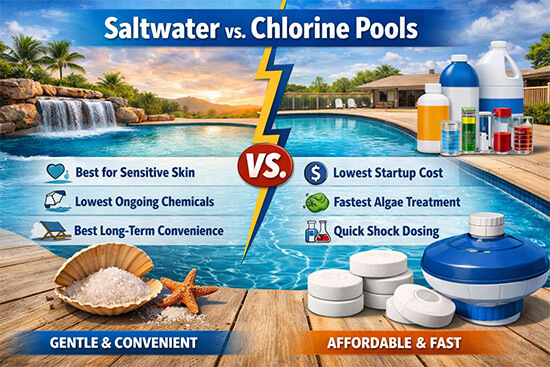
- Best for sensitive skin: Saltwater
- Lowest startup cost: Chlorine
- Lowest ongoing chemical handling: Saltwater
- Fastest algae treatment: Chlorine
- Best long-term convenience: Saltwater
Saltwater pool or traditional chlorine pool?
Both systems sanitize water effectively, but they differ significantly when it comes to cost, maintenance, swimmer comfort, and long-term ownership experience.
In this complete comparison guide, we’ll break down:
- How saltwater pools work how chlorine pools work
- The best pool system for sensitive skin
- Saltwater pool pros and cons chlorine pool pros and cons
- Detailed saltwater chlorine maintenance tips (chlorine pool maintenance cost)
- Saltwater pool vs chlorine cost comparison (updated for 2026 prices)
- Saltwater pool conversion cost
- Which type is best for your specific lifestyle
Pro Tip: If you’re also considering efficiency upgrades, check out our companion guide on How to Save Energy with Your Swimming Pool: A Complete Guide.
What’s the Difference Between Saltwater and Chlorine Pools?
Before deciding which is best for you, understand the basic science behind each option.
Many wonder: Is a saltwater pool worth it, and what are the real differences compared to chlorine systems?
If you want an in-depth breakdown on related swimming pool topics, explore our Pool Opening Guide, dive into the Saltwater Pool Benefits Article.
Saltwater Pools Explained
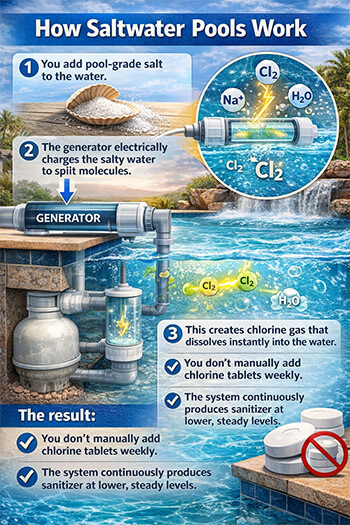 Saltwater pools use a salt chlorine generator (also called a salt system or salt cell) to convert dissolved salt into pure chlorine through electrolysis.
How it works?
● You add pool-grade salt to the water.
● The generator electrically charges the salty water to split molecules.
● This creates chlorine gas that dissolves instantly into the water.
The result:
● You don’t manually add chlorine tablets weekly.
● The system continuously produces sanitizer at lower, steady levels.
● The water typically feels softer and less harsh than in a traditional pool.
Important clarification: Saltwater pools are not chlorine-free.
They simply generate chlorine automatically, offering a distinct experience compared to the hands-on approach of a chlorine pool.
Chlorine Pools Explained
Chlorine pools require direct addition of sanitizer by the owner, such as:
- Liquid chlorine: Fast-acting but bulky to
- Tablets (Pucks): Convenient but can increase stabilizer (CYA) over
- Granules: Handy for spot
Chlorine tablet vs salt system: Owners must test chemistry and add chlorine manually. This industry-standard approach remains popular due to its lower startup cost and straightforward process.
Saltwater Pool Pros and Cons
Saltwater pools have become the top choice for new residential installations in 2026—but are saltwater pools worth it for everyone? Let’s weigh the benefits and drawbacks.
Benefits of Saltwater Pools
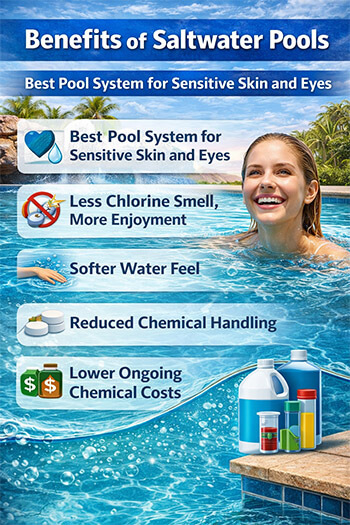 1. Best Pool System for Sensitive Skin and Eyes
The steady, lower concentration of chlorine reduces irritation, making saltwater the best pool system for sensitive skin—ideal for children, frequent swimmers, or those with eczema.
2. Less Chlorine Smell, More Enjoyment
That strong “public pool” odor is caused by chloramines, not pure chlorine. Salt systems keep chlorine at even levels, limiting chloramine formation.
3. Softer Water Feel
Salt acts as a natural water softener, so many describe the feel as “silky” or “mineral-like.”
4. Reduced Chemical Handling
You’ll add salt once or twice a year—the salt system handles your sanitation, so you don’t have to haul or store chlorine tablets constantly.
5. Lower Ongoing Chemical Costs
Although the initial saltwater pool conversion cost is higher, ongoing chemical purchases are lower, and you can expect savings after the initial few years.
Ready to upgrade? Discover the top-rated salt systems on Amazon for your saltwater pool conversion.
Drawbacks of Saltwater Pools
No system is perfect. Consider these saltwater pool cons before making the leap.
1. Higher Upfront and Conversion Costs
Saltwater pool conversion cost usually ranges from $1,000–$2,500, which covers the generator and professional installation—this is higher than the basic cost for setting up a chlorine pool.
2. Saltwater Pool Corrosion Problems
Salt is corrosive and can cause issues such as:
- Metal ladder and handrail corrosion
- Light fixture and stone deck damage
- Problems with heaters that use copper
Mitigation: Use corrosion-resistant materials and install sacrificial anodes to avoid saltwater pool corrosion problems.
3. Salt Cell Maintenance
Salt cells need:
- Cleaning: Every 3–6 months to remove mineral buildup
- Replacement: Every 3–7 years, often at a cost of $300–$800
Is your pool losing water faster than normal evaporation? Before you waste money on chemicals and refilling, grab our free step-by-step leak detection guide.
✔ How to perform accurate water loss tests
✔ Common leak locations most homeowners miss
✔ When DIY is enough — and when to call a pro
👉 Download Your Free Copy Today
Chlorine Pool Pros and Cons
Chlorine pools might be “traditional,” but they still offer several advantages—and some clear downsides.
Benefits of Chlorine Pools
1. Lower Initial Investment
Chlorine pool setup is affordable—no need for a salt generator—making it appealing for anyone on a tight budget.
2. Faster Chemical Adjustments
If you deal with algae or heavy swimmer loads, chlorine pools allow immediate corrections by adjusting liquid or shock chlorine—giving you total control.
3. Widely Available Products
Chlorine tablets, granules, and related supplies are available at any pool or hardware store.
4. Familiar Routine
Many owners are comfortable with routine chlorine pool maintenance—balancing pH, alkalinity, and CYA is a familiar chore.
Drawbacks of Chlorine Pools
1. Chlorine Pool Maintenance Cost and Time
You’ll spend more time and money on:
- Weekly chlorine tablet purchases
- Monitoring chemical levels
- Regular pool shocking
Chlorine pool maintenance cost can add up, especially during peak summer use.
2. Skin and Eye Irritation Risk
Improper balance or chemical spikes can cause red eyes, dry skin, and hair discoloration.
3. Stronger Odor
Without careful management, chlorine pools can develop chloramine odors.
Saltwater vs. Chlorine Pool Maintenance Cost and Comparison
Which system is easier and cheaper to maintain? Let’s see how they compare, including a handy cost breakdown for 2026.
| Maintenance Task | Saltwater Pool | Chlorine Pool |
| Weekly Tasks | Test chemistry & skim | Add chlorine tablets, test & skim |
| Monthly Tasks | Check salt levels | Shock pool, monitor stabilizer |
| Quarterly Tasks | Inspect & clean salt cell | Deep clean filter |
| Annual Tasks | Add salt (spring) | Drain/refill (if CYA is high) |
| Effort Level | Low (“set it and forget it”) | Medium/High (hands-on weekly) |
| Maintenance Cost | Lower after conversion | Ongoing higher cost for chemicals |
Tip: For a full breakdown of chlorine pool maintenance costs, see our in-depth guide on Pool Care & Maintenance Costs.
Need top-rated cleaners? Shop the best pool cleaning tools here for both saltwater pool and chlorine pool care.
Saltwater Pool vs Chlorine Cost Comparison (2026 Update with Data)
Is a saltwater pool worth it in the long run? Here’s a transparent look at costs, including saltwater pool vs chlorine cost comparison:
- Initial Setup / Conversion Cost: Saltwater: $1,000–$2,500 upfront for generator. Chlorine: Lower, no generator required.
- **The average chlorine pool owner spends $600–$900 per year on sanitizer and stabilizer. Saltwater owners typically reduce that to $200–$300 annually after installation.
- Equipment Replacement: Salt cell every 3–7 years ($300–$800), chlorine pools have minimal special equipment.
- Long-Term Total Cost: Often comparable over 5–7 years, with saltwater saving money on ongoing chemicals after recovering saltwater pool conversion cost.
Want expert savings? See our Amazon Storefront for pool maintenance bundles.
Is Saltwater Pool Worth It? Which Pool System Is Better for You?
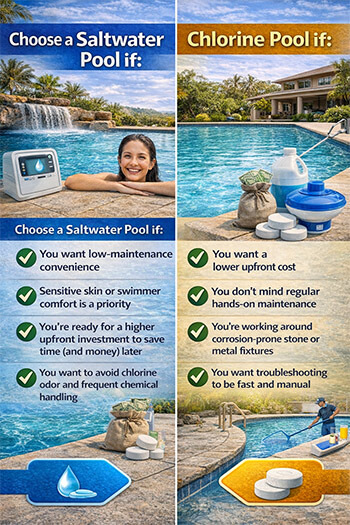 Choosing between saltwater and chlorine is about matching your goals and budget:
Choose a saltwater pool if:
● You want low-maintenance convenience
● Sensitive skin or swimmer comfort is a priority
● You’re ready for a higher upfront investment to save time (and money) later
● You want to avoid chlorine odor and frequent chemical handling
Choose a chlorine pool if:
● You want a lower upfront cost
● You don’t mind regular hands-on maintenance
● You’re working around corrosion-prone stone or metal fixtures
● You want troubleshooting to be fast and manual
Common Mistakes When Choosing Between Saltwater and Chlorine Pools
Choosing the right pool system involves more than just upfront cost or personal preference. Homeowners often make these common mistakes:
- Ignoring local climate: Weather impacts chlorine demand and evaporation Hot, sunny climates tend to favor saltwater pools, as they maintain more stable chlorine levels.
- Not considering decking material: Salt can accelerate wear on unsealed concrete, natural stone, and metals. Always check compatibility and consider sealing or alternative materials.
- Overlooking stabilizer buildup (CYA): Using chlorine tablets adds stabilizer to the water, which can build up and reduce chlorine effectiveness. Regular testing and partial water changes are
- Underestimating salt cell replacement cost: Salt cells typically need replacement every 3–7 years, so factor this future expense into your budget.
- Improper electrical bonding: Salt systems require proper grounding and bonding to prevent equipment corrosion and electrical hazards. Always consult a licensed pool electrician for installation.
By avoiding these pitfalls, you’ll make a more informed, long-lasting decision for your pool investment.
Final Verdict
There is no universally “better” system—only the one that fits your needs.
- For low-maintenance, silky water, and soft skin: Saltwater pools are worth it.
- For lower setup costs and more control: Chlorine remains a strong, budget-friendly choice.
Next Step: Master Your Pool Maintenance
Ready to upgrade? Compare top-rated salt chlorine generators here for hands-on product insights and best picks.
Found this guide helpful? Share it with your friends or on your favorite pool and DIY forums!
Frequently Asked Questions (FAQ)

Are saltwater pools safer than chlorine pools?
● Yes, both are equally safe when properly maintained. Saltwater often means less chemical handling, but both sanitize effectively.
Do saltwater pools taste salty?
● Not noticeably. Salt levels are much lower than the ocean—think a tear, not seawater.
Is a saltwater pool worth it for resale value?
● Usually, yes. Buyers like the low-maintenance, sensitive-skin benefits of a salt system, but overall pool condition matters most.
What is the saltwater pool conversion cost?
● Expect $1,000–$2,500 for the generator and installation in 2026.
Are there common saltwater pool corrosion problems?
● Yes, but you can minimize them with corrosion-resistant materials and regular checks.
Which is better for kids and sensitive skin—saltwater or chlorine?
● Saltwater pools are widely seen as the best pool system for sensitive skin thanks to gentler water and more consistent chlorine.
How long does a salt cell last?
● Most salt cells last 3–7 years, depending on use, maintenance, and water quality. Proper cleaning extends the lifespan.
Can you convert a chlorine pool to saltwater?
● Yes. Conversion is straightforward—install a salt chlorine generator and add pool salt. No need to drain the pool unless otherwise required.
Do saltwater pools damage concrete?
● When properly maintained, saltwater pools are safe for most pool finishes. However, salt can speed up wear on unsealed concrete or porous stone—using sealants and regular cleaning is recommended.
Which pool system is better for hot climates?
● Both perform well, but saltwater pools offer more stable chlorine levels in high temperatures and direct sun, reducing the risk of algae growth in hot climates.
 Suspect your pool is losing water?
 Suspect your pool is losing water?
Download our FREE Pool Leak Detection Ebook and learn how to spot leaks early, perform simple at-home tests, and know when it’s time to call a professional.
Stay Connected for More Pool Tips
Follow us for expert advice on pool maintenance, leak detection, and backyard safety.
- YouTube: Pool Leak Detection LLC
- Instagram: @poolleakdetectionllc
- Facebook: Pool Leak Detection LLC
- Pinterest: Pool Leak Detection LLC
- LinkedIn: Chris Ilias