
How to Calculate Swimming Pool Volume in Gallons
Calculating your pool’s volume is the foundation of proper maintenance, yet it’s often overlooked.
As a pool professional, I frequently see cloudy water caused by inaccurate estimates, equipment failure, and wasted money.
Chemicals and filters are engineered for specific gallon ranges; when you guess, problems follow.
In this guide, we’ll provide the exact formulas professionals use for any pool shape so you can maintain a crystal-clear pool with confidence.
How Many Gallons Is My Swimming Pool?
To calculate swimming pool volume in gallons, multiply the pool’s surface area by its average depth, then convert cubic feet to gallons using 7.5.
General Formula:
Pool Area × Average Depth × 7.5 = Total Gallons
The exact formula depends on whether your pool is rectangular, round, or freeform.
 Why You Must Know Your Pool Volume
 Why You Must Know Your Pool Volume
Before we dive into the math, let’s understand why this figure matters.
Your pool volume determines everything about your water chemistry and equipment efficiency.
Pool Volume Is the Foundation of Proper Pool Care
Knowing your pool’s gallon capacity affects every aspect of maintenance, including:
- Chemical balancing
- Equipment sizing
- Leak detection
- Energy efficiency
Precise Chemical Dosing
Pool chemicals, like chlorine and shock, are potent substances. Manufacturers provide dosage instructions based on specific water volumes (usually per 10,000 gallons).
If you underestimate your volume, your water remains unsanitary. If you overestimate, you risk damaging pool liners, corroding equipment, and causing swimmer discomfort.
Equipment Sizing
Pumps, filters, and heaters are rated for specific pool sizes.
A heater designed for a 10,000-gallon pool will struggle to warm a 20,000-gallon pool, driving up your energy bills while delivering poor results.
Wondering if variable-speed pool pumps are worth it? We’ve got you covered.
Saving Money
Guesswork is expensive. Overdosing chemicals means you run out faster and have to buy more. It also means you might need to buy corrective chemicals to fix the imbalance you created.
Knowing your exact volume stops this cycle of waste.
That’s why accurate volume calculation is the first step in every professional pool care process.
 How Pool Professionals Calculate Volume
 How Pool Professionals Calculate Volume
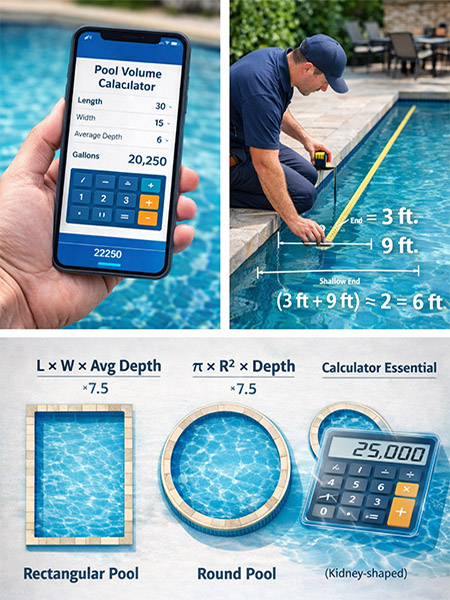
Professional pool technicians calculate volume using measured averages rather than guesses. This includes:
- Measuring multiple width points on freeform pools
- Averaging shallow and deep depths
- Separating pools with drop-offs or hopper bottoms into sections
This method ensures accurate chemical dosing, protects liners and finishes, and prevents costly overcorrections.
The Magic Number: 7.5
For most of these calculations, you will see the number 7.5. This is the conversion factor because one cubic foot of water contains approximately 7.5 gallons.
How to Calculate Rectangular Pool Volume
Rectangular pools are the easiest to calculate. You simply need to determine the cubic footage and convert it to gallons.
The Formula:
Length × Width × Average Depth × 7.5 = Total Gallons
Step 1: Find the Average Depth
Most pools have a shallow end and a deep end. To find the average depth:
- Measure the depth at the shallow end.
- Measure the depth at the deep end.
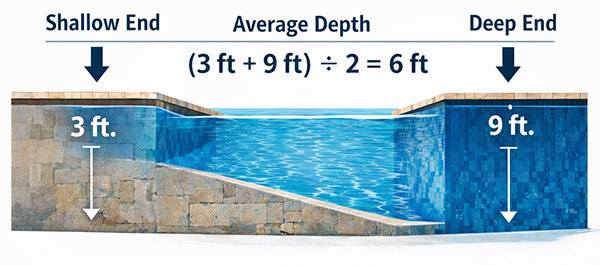
- Add these two numbers together and divide by 2.
(Shallow Depth + Deep Depth) ÷ 2 = Average Depth
Step 2: Calculate the Volume
Let’s say you have a pool that is 40 feet long and 20 feet wide. The shallow end is 3 feet, and the deep end is 9 feet.
Average Depth: (3 + 9) ÷ 2 = 6 feet.
Calculation: 40 (Length) × 20 (Width) × 6 (Average Depth) × 7.5.
Result: 40 × 20 × 6 × 7.5 = 36,000 gallons.
How to Calculate Round Pool Volume
Round pools require a slightly different approach involving the radius (half of the diameter) and Pi (3.14).
The Formula:
3.14 × Radius² × Average Depth × 7.5 = Total Gallons
Step 1: Measure the Diameter
Measure the width of the pool at its widest point. Divide this number by 2 to get the radius. For example, if your pool is 24 feet across, your radius is 12 feet.
Step 2: Calculate the Volume
Let’s assume your 24-foot round pool has a consistent depth of 4 feet.
Radius Squared: 12 × 12 = 144.
Calculation: 3.14 × 144 × 4 × 7.5.
Result: 13,564.8 gallons (round up to 13,600 gallons).
 How to Calculate Freeform Pool Volume
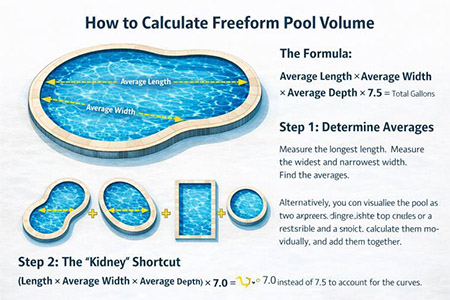 How to Calculate Freeform Pool Volume
Freeform or kidney-shaped pools are popular for their aesthetic appeal, but they can be tricky to measure.
Because there are no straight lines, you have to “wing it” slightly using averages.
The Formula:
Average Length × Average Width × Average Depth × 7.5 = Total Gallons
Step 1: Determine Averages
Measure the length at the longest point. Then, measure the width at the widest point and the narrowest point, and find the average width.
Alternatively, you can visualize the pool as two separate shapes (like two circles or a rectangle and a circle), calculate them individually, and add them together.
Step 2: The “Kidney” Shortcut
For a standard kidney-shaped pool, you can use this multiplier formula: (Length × Average Width × Average Depth) × 7.0 = Total Gallons
Note that we use 7.0 instead of 7.5 to account for the curves that cut into the total volume.
Dealing with Variable Depths
The formulas above assume a gradual slope from shallow to deep. However, some pools have a “drop-off” or a hopper bottom.
If your pool has a sharp drop-off, treat the shallow area and the deep area as two separate swimming pools.
Calculate the volume of the shallow section using the rectangular formula. Then, calculate the deep section separately. Add the two totals together for your final volume.
When to Hire a Pool Professional
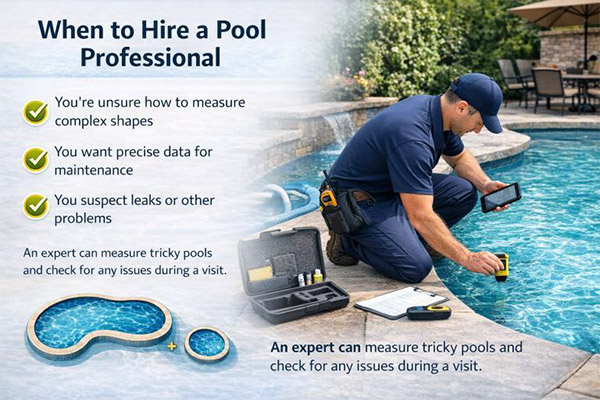
While these formulas work for 90% of pools, complex shapes with swim-outs, spas, and irregular bottoms can be difficult to measure accurately.
If you are unsure, consider hiring a pool professional. An expert can provide a precise measurement, ensuring your swimming pool maintenance tips are based on accurate data.
They can also inspect your pool for other issues while they are there, such as leak concerns.
Take Your Pool Care to the Next Level
Now that you know your pool’s volume, you are ready to manage your water chemistry like a pro. Accurate data is the secret to crystal-clear water and equipment that lasts for years.
If you are looking for more ways to protect your investment, we have some great resources for you:
- Suspect a leak? Don’t let water loss drain your
- Need visual guides? Subscribe to our YouTube Channel for weekly tutorials on cleaning, chemical balancing, and equipment repair.
- Want more tips? Check out our related blog post on 20 Common Questions About Pool Leaks (And How to Fix Them) to master the basics.
- Ready to stock up? Visit our Amazon Storefront for our curated list of the best pool care tools, testing kits, and maintenance gear.
Knowing your swimming pool’s exact volume is one of the most important steps in proper water care.
When your calculations are accurate, chemical dosing becomes safer, equipment performs better, and long-term maintenance costs stay under control.
If your pool has an unusual shape or you’re unsure about your measurements, working with a qualified pool professional can help ensure everything is calculated correctly from the start.
If you found this guide helpful, feel free to share it with other pool owners who may benefit.
For more expert tips on pool maintenance, leak detection, and water chemistry, explore our related articles or download our free guide on how to identify pool leaks early.
A well-measured pool is the foundation of a trouble-free swimming season.